2012年4月16日 星期一
Week 9 The relationship between BPR and the core competitiveness

2012年4月15日 星期日
Week 8 How important is business process in BPR?
Source / Reference:
1) “Organizational Redesign
(Business Process Re-engineering) (BPR)”
http://www.smthacker.co.uk/organisational_redesign.htm
Subject:
How important is business process in BPR?
================================================================

Response:
Processes become the
focus of attention of many management gurus and top CEO in the past 10 years.
Almost all the articles in
the book “Harvard Business School Harvard Management classic Series” focus around
the transformation of process that can develop strategy theme successfully.
In simple words, the
process is the order of things. Davenport’s definition given is “the business
process is orderly work activities across time and space, it has a start point
and end point, and clear inputs and outputs”.
The main point of this
definition is that it points out the "process" must have "time
control", namely a clear beginning and end. At the same time, the process
must have clear expectations and measure results, which are clear input and
output.
On the surface, the
enterprise organization is divided by the businesses and functions, but in fact
the important role is the process. Present in the actual process are personnel,
material and cash flow, but information technology companies need to pay close
attention to hidden "knowledge flow" and "information flow"
that behind these visible "flow". The knowledge and information flow are
the value of the enterprise resource.
Different departments and
different personnel, and outside the enterprise, is the inspection process is
complete, are the touchstone of process. Hence, the process as a combination of
activities is actually an effective channel of the value chain to pass.
Through the process to
re-understanding of the enterprise, is one of the most important management ideas
of the late 20th century.
Measure the different
states of the process, in fact, is a measure of the resource utilization
efficiency and the effect of transform resources in a process, such as time,
resources, human resources, material resources and financial resources.
Information flow process is complete, effective, a sign of health, which gives
a measure may be.
If there is no effective
measure, the process cannot achieve a normal and orderly operation.
2012年4月14日 星期六
Week 7 What are the characteristics of BPR methodologies?
Source / Reference:
1) "Reviewing Engineering
Methodologies"
http://www.prosci.com/bpr_method.htm
Subject:
What are the characteristics of BPR methodologies?
================================================================
To do any works there have procedural requirements. Enterprise business
processes are clearly a work or something, what order, what standards, what the
time to complete. Whether large or small enterprises, regardless of the
technology-paid business or process traditional enterprise, regardless of the
lean enterprise or extensive management of the enterprise, has its own business
processes. Only the enterprise has advanced management has more scientific of business
processes, the attitude can also attaches great importance to the institutional
building of the business processes to improve business processes based on
changes in the market in time.
BPR implementation method
is specific, there are four steps: setting goals (visioning), research,
innovation and implementation. It did not analyze the BPR process. It has a
direct jump to the stage of the innovation and implementation. Therefore, the
core elements of BPR is demolished for redevelopment of the methodology, this
approach emphasizes the set goals, research, and re-establish the business
process, regardless of the previous status of the enterprise.
Application of BPR method
is to encourage creative thinking. BPR methods are not limited to the original thinking,
but on the basis of innovation, design a new process, and put into application.
The existing processes in
many companies often cannot meet the needs of users, and even many of the
processes already poor to the point where you want to waste. In addition, the
process of continuous improvement process, we need to measure, analyze and
rethinking, these all need to take a very long time, so many companies eager.
Therefore, many companies have adopted BPR method, the BPR approach with
particular emphasis on IT technology, the ERP system. This enterprise companies
include Hewlett-Packard and Ford.
BPR is fast, it do not require
a lot of time for analysis. BPR process is not drawn from the analysis, but
from the best practices. According to the best practices of world-class
company, to develop similar processes and implementation procedures, thereby
greatly saving time.
Week 6 What are the success and failure factors of BPR
process?
Source / Reference:
1) "Success and failure factors of
BPR"
http://www.powerfulwords.co.uk/sample-assignments/project-management/success-and-failure-factors-of-bpr.php
Subject:
What are the success and failure factors of BPR process?
================================================================
About 70% of the BPR
projects failed to achieve the intended purpose or fail in the end. A part of
the reasons for the failure is due to the unrealistic vision and expectations
of the restructuring, and the lack of attention and understanding of the key
factors important to note that in the reengineering process is the key reasons
for the failure.
Although the companies
spend a lot of money, time and effort to restructure process, but about 50 to
70% of the enterprises did not achieve the purpose of reengineering or get a large
improvement.
Reasons
for the failure
1.
Wrong choice of the timing and conditions of
the reengineering
The enterprise does not
necessarily need to carry out a thorough reorganization. Typically, the
implementation of enterprise business process reengineering three categories:
enterprise diehard acceptable but is about to troubled companies and the
current situation but I hope the competitors far behind the enterprise.
The implementation of
BPR, although high-yield projects, is also accompanied by great risks, so must
be clear the motivation of business process reengineering, and to create its
unique core competitiveness.
2.
Error selection of the business process
You must first analysis
clearly all the processes, problems the most prominent part of reorganization
or core areas. How to determine this process is a hard work. The specific
analysis must consider the following issues, whether the process is become the
"bottleneck" of the enterprise development? Can this process resolve the
problem after the reorganization of the enterprises that is facing the crisis?
How large is the probability of success of the process reengineering? How
serious of the consequences of failure of process reengineering?
3.
The wrong interpretation of the role of IT
BPR is equivalent in IT
is wrong, while ignoring the role of IT is also wrong. The true value of IT is
that it provides the necessary tools and means, so people have the ability to
break the traditional rules of management, and to create new ways of working to
bring new growth point of the enterprise.
4.
The immature of BPR
So far, BPR is just a
thought, it cannot be called a theory. BPR is still far from mature as a
revolutionary theory, the deep-seated understanding of the internal mechanism
of BPR and the nature of law is far from established. Unsound methodology,
analytical tools are not effective, both are the factors impeding the success of
BPR in practice.
In addition, the causes of failure include, focus on business processes, recombinant confused with other conventional ways of improvement, only concerned with the design of the process while ignoring the other constraints; time delay for too long so that people lose the reorganization patience and reorganization of all business processes.
2012年3月4日 星期日
Week 5 What are the commonly used practices of BPR project implementation?
Source / Reference:
1) "MIPIM: Framework for Business Process Improvement" by Sola Adesola 1998
http://oxfordbrookes.academia.edu/SolaAdesola/Papers/1290041/MIPIM_Framework_for_Business_Process_Improvement
2) “Study on Business Processes Re-engineering Based on Value Chain of Construction Enterprise” by Liu Jingyan 2010
http://www.seiofbluemountain.com/upload/product/201002/126502070736ltzdm.pdf
Subject:
What are the commonly used practices of BPR project implementation?
================================================================
Response:
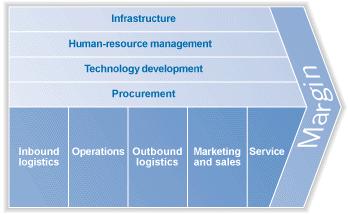 Value chain analysis is to identify a "value"
whether to give the enterprise a competitive advantage. This theory was first published in the
Potter's a paper on how to join chain analysis and information technology together,
later to be developed into an important means of corporate strategy, the
construction of enterprise information technology is very important. Analysis of
the value of each chain of activities, you can find out what kinds of
activities are in need of rehabilitation, which can
achieve differentiation and to generate cost advantages.
Value chain analysis is to identify a "value"
whether to give the enterprise a competitive advantage. This theory was first published in the
Potter's a paper on how to join chain analysis and information technology together,
later to be developed into an important means of corporate strategy, the
construction of enterprise information technology is very important. Analysis of
the value of each chain of activities, you can find out what kinds of
activities are in need of rehabilitation, which can
achieve differentiation and to generate cost advantages.
Source / Reference:
1) "MIPIM: Framework for Business Process Improvement" by Sola Adesola 1998
http://oxfordbrookes.academia.edu/SolaAdesola/Papers/1290041/MIPIM_Framework_for_Business_Process_Improvement
2) “Study on Business Processes Re-engineering Based on Value Chain of Construction Enterprise” by Liu Jingyan 2010
http://www.seiofbluemountain.com/upload/product/201002/126502070736ltzdm.pdf
Subject:
What are the commonly used practices of BPR project implementation?
================================================================
Response:
For an enterprise, BPR is a significant and complex
systems engineering to a wide range of activities and work involved in the
project implementation process. We need to
understand some of the methods and tools for BPR. Techniques and methods can be used in the BPR. Here are some commonly used approaches.
Brainstorming and the Delphi method
Discuss the company's strategic vision, to determine the
timing of reengineering the process, brainstorming and the Delphi method is two useful ways. In brainstorming
discussions, participants were encouraged to put forward as bold vision. Use brainstorming to help us find the shortcomings in the
existing business process, and proposed a fundamental transformation of ideas. Delphi rule is often used to demonstrate the feasibility
of reengineering. After
several rounds of solicitation of experts’
views, receive the unanimous opinion ultimately. It is very
useful to reduce the risk of the BPR, set the correct information strategy.
Value chain
analysis
Value chain analysis is to identify a "value"
whether to give the enterprise a competitive advantage. This theory was first published in the
Potter's a paper on how to join chain analysis and information technology together,
later to be developed into an important means of corporate strategy, the
construction of enterprise information technology is very important. Analysis of
the value of each chain of activities, you can find out what kinds of
activities are in need of rehabilitation, which can
achieve differentiation and to generate cost advantages.
ABC cost method, also known as operating cost analysis
Mainly used for the description and cost analysis of
existing processes. The ABC cost
analysis and value chain analysis is similar to a certain degree of existing business
decomposition, and find out the basic activities. However, the operating cost analysis focus on analyzes the cost of various activities, especially
activities in the consumption of labor, and resources etc.
Benchmarking
method
The benchmarking method can be used in the establishment
of the reform objectives and vision, to determine the benchmark for other
aspects of process reengineering. Have a number of successful businesses in many
industries, these business practices can be emulated by other enterprises in
the industry, can also be some specific indicators of these enterprises as a
benchmark for other companies.
2012年1月15日 星期日
Week 4 Which alignment strategy in SAM model is the best?
Source / Reference:
1) "A framework for
integrating IT governance and business/IT alignment principles" by Maur,
W. in der, Walbeek, W. van, Batenburg
2009
http://nvl002.nivel.nl/postprint/PPpp3622.pdf
2) “VMware Delivers Real
Financial Results for Virtualization Business” by Sean Michael Kerner http://www.internetnews.com/itmanagement/vmware-delivers-real-financial-results-for-virtualization-business-.html
Subject:
In Lect 4 - Which alignment strategy in SAM
model is the best? and why?
======================================================================
Response:
In
Lecture 4, Strategic Alignment Model (SAM) was
discussed. Strategic Alignment
Model (SAM) is the model used to propose a set of IT strategy planning
framework for thinking to help business to check the consistency between the information
architecture and business strategy, as follow:

There are
four-led alignment strategies of the strategy alignment model. It is Strategy
Execution, Technology Potential, Competitive potential and Service level.
Strategy Execution
Strategy
Execution focused that the operations strategy of business is the driver of organization
and IT choices. It is a traditional, layer of strategy management thinking. Senior(Top)
management formulate business strategy, and IT department implement the
strategy only. That is, the top management is the strategy formulator and the
IT management is the strategy implementer.
Technology Potential
Technology Potential also focused that the
operations strategy is business power, however its implementation is
indispensable to the support of the IT strategy, IT strategic needs both of business
operations and business operations related to IT infrastructure and processes
need. The business executives must have IT thinking and fully understand the
role of IT strategy to support business
operations strategy and develop the most support IT strategy. IT managers in this mode is the role of the builders of
the enterprise IT architecture, he was responsible for the design of IT
architecture consistent with the external
environment, and is responsible for the efficient operation of the IT strategy.
Competitive Potential
Competitive Potential to coordinate the
mode from the following three areas to further enhance the strategic position
and role of IT:
- Impact of new products and services
- Impact of key strategic attributes
- The development of a new relationship model
Different from the
first two modes, the competitive potential to coordinate the model advocated by
the IT strategy to transform or enhance the original operation strategy
, while the former two modes, depending on the operating strategy.
Service Level
Service Level is committed to build the world's leading IT systems
within the organization to improve service standards. In this mode, operating
strategy play a non-directly related role. This coordinate mode is
generally considered to be very necessary, but not be able to fully guarantee
the enterprise effective use of IT resources, rapid growth, the changes in the market to
make timely and correct response.
Executives play a
role in this model is the prioritization member. Determine how effective
allocation of scarce resources within the enterprise,
and the same time, he also responsible for the configuration of the enterprise
resources in the IT market. In this alignment, IT
managers as a member of the corporate leadership team, responsible for internal
operations in line with the special mission of high-level instructions.
I think there is
no best alignment strategy. We should choose the right alignment for the right
situations to create competitive advantage for
the business.
訂閱:
文章 (Atom)